Most people shopping for a skin resurfacing treatment assume all peels work the same way. They dissolve the outer layer of skin, cause some redness, and reveal fresher skin underneath. The Green Sea Peel works differently. This unique approach draws interest from those who have struggled with traditional methods. Understanding what actually separates it from a regular chemical peel helps you decide which one is right for your skin before you book anything.
The Green Sea Peel is a corrective resurfacing treatment that uses a biological rather than chemical mechanism to trigger skin renewal. It uses natural structures from sea sponges to create tiny channels in the skin. This helps activate the skin’s own repair process, instead of using acid to dissolve the surface. That one change impacts recovery, fits various skin tones, and affects the results you can expect.
What Is the Difference Between a Green Sea Peel and a Chemical Peel?
1. Two completely different mechanisms
A regular chemical peel uses acids, most commonly AHA, BHA, TCA, or lactic acid, to dissolve the bonds holding dead skin cells together. The acid breaks down the outer skin layer and forces it to shed, revealing newer skin below. The strength of the acid determines how deep the peel goes and how significant the recovery period is.
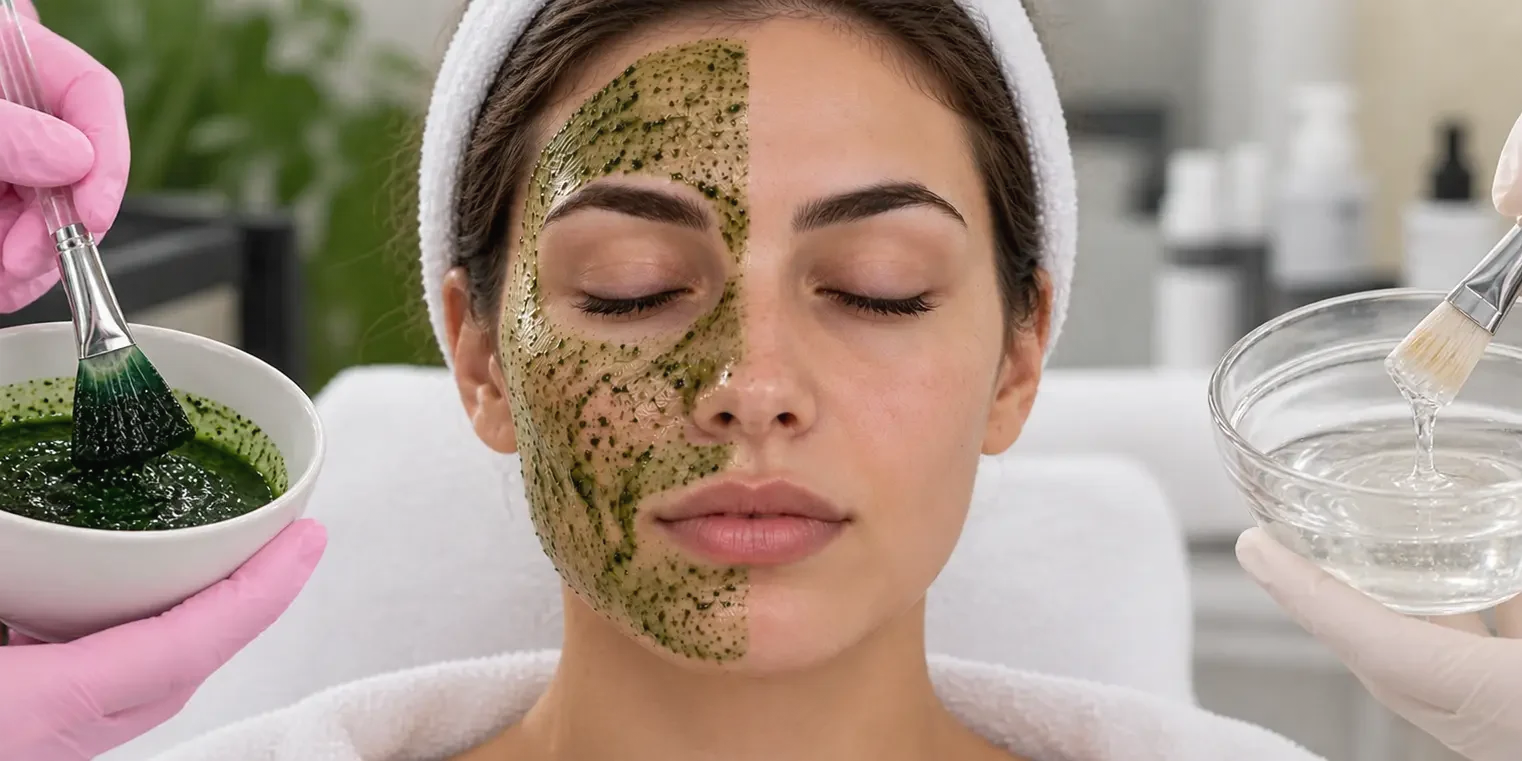
The Green Sea Peel vs Chemical Peel distinction starts at this fundamental level. The Green Sea Peel does not use acids. It uses marine sponge spicules. These are tiny, needle-like silica structures found in sea sponges. When massaged into the skin by a trained esthetician, these spicules create thousands of microscopic channels in the outer skin layer. The skin detects the need for repair. It then activates collagen production and speeds up cell turnover.
2. Physical vs chemical: what the skin actually experiences
Physical exfoliation with spicules gently disrupts the skin. This process boosts the skin’s healing response. It does this without changing the pH or adding acids to the tissue. Chemical exfoliation through a peel changes the chemistry of the skin surface to force shedding. Both produce peeling and renewal. The path to get there is entirely different, and that path determines who can safely use each treatment.
How Does a Green Sea Peel Work on the Skin?
1. The spicule mechanism explained simply
The question most first-time clients ask is how this peel works. The KRX formula at Karmina Beauty Clinic includes Hydrolyzed Sea Sponge extract, Durvillea Antarctica seaweed, and algae extract. During the session, the formula is massaged into clean skin.
The spicules embed into the upper skin layer and create thousands of tiny channels simultaneously. Each channel sends a microinjury signal. This tells the skin to make new collagen. It also speeds up the process of bringing fresh cells to the surface. This happens faster than the skin’s usual renewal cycle.
2. What you feel during the treatment
The sensation during a GSP treatment at Karmina Beauty Clinic is described by most clients as a tingling or mild prickling warmth. It is not painful the way a medium or deep chemical peel can be. The discomfort is real but manageable and typically peaks during the application phase before settling.
3. The day-by-day skin response
The skin reacts to the Green Sea Peel steadily. This is key to know before you book, especially if you have an upcoming event.
- Immediately after: Redness and warmth similar to mild sunburn, skin feels sensitive and tight
- Hours 1 to 24: Redness often intensifies a few hours after treatment before beginning to settle
- Days 1 to 3: A prickling sensation continues, especially in warm environments or after hot showers
- Days 3 to 7: Peeling begins, ranging from light flaking to larger sheets depending on skin type
- Days 5 to 10: Fresh, smoother, brighter skin emerges as shedding completes
Is Green Sea Peel Better Than a Chemical Peel?
1. Where the Green Sea Peel Wins
Green Sea Peel vs. chemical peel: which is better is not a question with one universal answer. It depends on your skin type, concern, and tolerance. The Green Sea Peel has clear advantages in specific situations.
It is safe for all Fitzpatrick skin tones, including deeper skin tones that carry a higher risk of post-inflammatory hyperpigmentation from acid-based peels. It is also considered pregnancy-safe, which is a significant differentiator. The spicules provide physical stimulation instead of using chemicals. This makes them ideal for people with skin that reacts badly to acid-based treatments.
- Safe for all skin tones, including Fitzpatrick IV through VI, where acid peels carry pigmentation risk
- Pregnancy-safe, unlike most acid-based chemical peels
- Delivers similar stimulation to microneedling without needles
- Effective for Green Sea Peel for enlarged pores and uneven texture
- Strong results for Green Sea Peel for pigmentation, including post-acne marks and sun spots
2. Where a chemical peel is still the stronger choice
A chemical peel NYC best types for acne hyperpigmentation comparison shows that some acid peels work better than others. TCA and Jessner formulas can penetrate deeper than the Green Sea Peel. This means they often give quicker results for severe sun damage or thick, damaged skin.
If you have deep textural concerns or very heavy pigmentation built up over many years, a chemical peel at the right concentration may produce a more dramatic single-session result.
| Factor | Green Sea Peel | Chemical Peel |
|---|---|---|
| How it works | Marine spicules create microscopic channels physically | Acids dissolve surface skin cell bonds chemically |
| Skin tone safety | All Fitzpatrick types including darker tones | Risk of pigmentation on Fitzpatrick IV and above |
| Pregnancy safe | Yes | Most are not recommended during pregnancy |
| Downtime | 3 to 7 days of peeling, redness settles in 48 hours | Varies widely: 2 days for superficial to 2 weeks for deep |
| Sensation | Tingling and prickling warmth | Burning or stinging depending on acid strength |
| Best for | Pigmentation, pores, texture, acne scars, sensitive skin | Heavy sun damage, deep wrinkles, severe discolouration |
| Collagen stimulation | Yes, through spicule channel repair response | Indirect through wound healing after acid application |
| Price at Karmina | $200 per session | Varies by peel type and depth |
Does Green Sea Peel Hurt More Than a Chemical Peel?
Does a green sea peel hurt more than a chemical peel is a fair concern. The answer for most people is no. A superficial or medium chemical peel with glycolic or TCA acid usually feels more intense during application. Many clients notice a strong burning sensation. In contrast, the Green Sea Peel often causes a milder prickling warmth. The discomfort from the spicules is more of an active tingling than a sharp sting.
Clients are often surprised by the Green Sea Peel. It’s not the session itself, but the prickling sensation that can last up to 72 hours afterward. This happens because the spicules continue to work within the skin after the treatment ends. The prickling intensifies in warm environments and after hot showers. It is not an allergic reaction, and it is not a sign that something went wrong. It is a normal part of how the treatment works.
How Long Do Green Sea Peel Results Last?
How long green sea peel results last depends on skin condition, sun exposure, and home care habits. Most clients see their best skin between days seven and fourteen after peeling completes. Collagen production starts with the spicules and keeps building for weeks. This means the skin improves even after the visible peeling phase is over.
For better results with acne scars, pigmentation, and texture, have two to three sessions. Space them four to six weeks apart. This approach works much better than just one session. Maintenance sessions every two to three months keep results holding while continuing to support collagen production in the treated areas.
Green Sea Peel downtime vs chemical peel downtime in practice means a more predictable, manageable recovery window. Most clients feel at ease in public by days seven to ten. However, a medium to deep chemical peel may need two weeks off for the skin to look presentable.
Final Thoughts
The Green Sea Peel and a chemical peel both produce peeling, renewal, and improved skin over time. What separates them is not the result but the mechanism, the safety profile, and who each treatment suits. If you have sensitive skin, are pregnant, or have had mixed results with chemical peels, the Green Sea Peel offers a safer option. It uses a different method but still gives similar results. If your concern is severe sun damage or deep structural scarring, a well-matched chemical peel may be the stronger single-session option. Most clients benefit from understanding both before committing to either.
Not sure which treatment is right for your skin? Book a Green Sea Peel consultation at Karmina Beauty Clinic in Forest Hills, Queens.
Frequently Asked Questions
Q1. What is the difference between a green sea peel and a chemical peel?
A Green Sea Peel uses marine sponge spicules for physical renewal. A chemical peel uses acids for chemical exfoliation of the skin surface.
Q2. How does a green sea peel work?
Spicules create thousands of microscopic channels that signal the skin to activate collagen production and accelerate its natural cell renewal cycle.
Q3. Is green sea peel better than a chemical peel?
For sensitive skin, darker skin tones, and pregnancy, yes. For severe sun damage or deep wrinkles, the GSP treatment may need to be paired with other options.
Q4. Does green sea peel hurt?
The session produces a tingling warmth. A mild prickling sensation continues for up to 72 hours after the Green Sea Peel Forest Hills treatment ends.
Q5. How long does green sea peel last and how long does peeling take?
Peeling lasts three to seven days. Fresh skin appears by days five to ten. Collagen production continues improving skin for several weeks after.
Q6. Is green sea peel good for acne scars?
Yes. The Green Sea Peel for pigmentation and shallow acne scars works by triggering collagen repair at the scar site with consistent sessions.
Q7. Why does pigmentation look darker after a green sea peel?
Existing spots temporarily darken as the skin activates its renewal process. This is normal and resolves as peeling completes over days five to ten.
Q8. How much does a green sea peel cost in NYC?
The Green Sea Peel Forest Hills session at Karmina is $200. Cherry financing starts at $19 per month, with two-minute approval available.