Hair loss affects millions of people every year, and the search for a solution that actually works without surgery keeps growing. PRP for hair loss has moved from specialist clinics into mainstream conversations, and more people are asking whether it genuinely delivers regrowth or simply slows the shedding process.
This guide directly answers that question. It uses real clinical evidence, explains what happens during treatment, and sets honest expectations for results. If you are considering PRP for hair loss and want to know what the research and real client outcomes actually show, this is the place to start.
Does PRP Therapy Actually Regrow Hair or Just Slow Shedding?
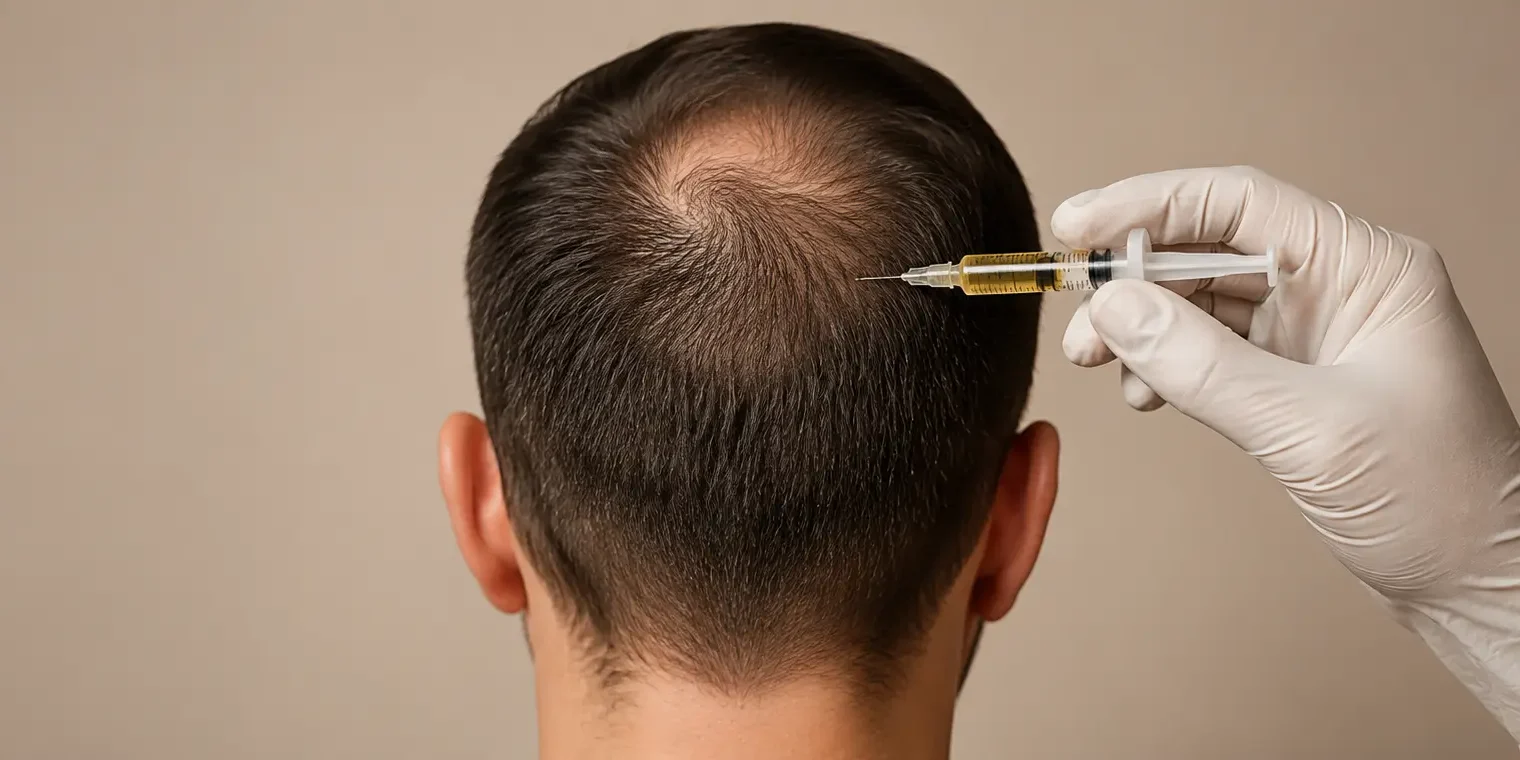
The honest answer is both. Does PRP regrow hair? Yes, it can, particularly when treatment begins before follicles have fully miniaturized. PRP for hair loss works by injecting platelet-rich plasma directly into the scalp. The concentrated platelet-rich plasma growth factors in the treatment signal dormant or weakened follicles to reactivate, extend their active growth phase, and produce thicker, stronger strands.
A 2019 study in the Journal of Cutaneous and Aesthetic Surgery looked at hair count, shaft diameter, and root strength in men with androgenic alopecia. This was done after they had four PRP sessions. All three markers improved significantly. The hair count increased by an average of 33 % in treated areas, and shaft diameter improved by 22 % compared to the control group. These are measurable regrowth outcomes, not just a reduction in shedding.
For men and women with complete follicle loss in an area, PRP will not regenerate hair from scratch. But for anyone with active thinning where follicles are still present, PRP treatment for hair loss consistently shows clinically meaningful improvement and PRP therapy combats hair loss in men more broadly.
How Effective Is PRP for Treating Male Pattern Baldness?
Androgenic alopecia treatment with PRP is one of the most studied applications of the technique. Male pattern baldness occurs in a set pattern due to DHT sensitivity in hair follicles. PRP helps by improving blood flow, reducing inflammation, and providing growth factors that fight the miniaturization of hair.
What Research Shows About PRP Hair Regrowth Results
Multiple clinical studies prove that PRP hair treatment works incredibly well for male pattern baldness. In fact, a major review of 11 different studies found that patients who completed the full treatment saw their hair density increase by an average of 25% to 45%. Even better, these thicker results lasted well past the six-month mark, proving that the treatment keeps working long after your sessions are done.
Is PRP Effective for Hair Loss in Women Too?
Yes. Female pattern hair loss and diffuse thinning from hormonal shifts respond well to PRP. Women generally have more active follicles spread across their scalp than men. This means the treatment can stimulate more viable follicles. Clinical outcomes in women are comparable to men when treatment starts at a similar stage.
What Happens at the Follicle Level During Treatment
Hair follicle stimulation through PRP works by using the natural growth factors found in your own blood, including PDGF, VEGF, EGF, and IGF-1. These growth factors are injected into the scalp, where they help reactivate weak hair follicles and move them from the resting phase into the active growth phase. Scalp injection therapy sends a natural signal that encourages healthier, stronger hair growth.
How Long Does It Take for PRP to Regrow Hair?
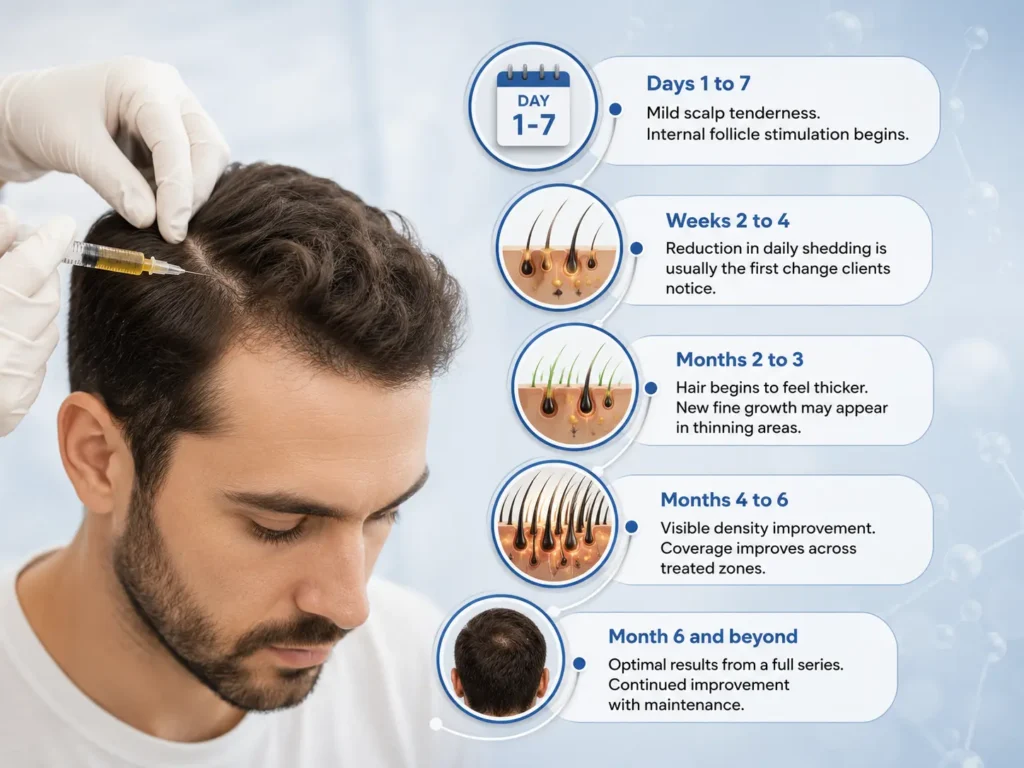
This is the question most clients want answered before committing to a full course. The timeline for PRP hair loss before and after results follows a consistent pattern across clinical settings and real-world clients.
| Timeframe | What to Expect |
| Days 1 to 7 | Mild scalp tenderness. Internal follicle stimulation begins. |
| Weeks 2 to 4 | Reduction in daily shedding is usually the first change clients notice. |
| Months 2 to 3 | Hair begins to feel thicker. New fine growth may appear in thinning areas. |
| Months 4 to 6 | Visible density improvement. Coverage improves across treated zones. |
| Month 6 and beyond | Optimal results from a full series. Continued improvement with maintenance. |
A 34-year-old client at Karmina Beauty Clinic came to us with a receding hairline and early thinning at the crown. After completing five PRP sessions over five months, he noticed much less hair fall while washing and sleeping. His hairstylist also saw new hair growth around the temples. This is the type of gradual improvement many men experience with consistent PRP treatment.
Does PRP Work for Receding Hairline and Crown Thinning
Does PRP work for a receding hairline? Yes, though the degree of response depends on how early treatment begins. The hairline and crown are the areas most commonly affected by androgenic alopecia, and they are also the areas that respond best when follicles are still active.
Non-surgical hair restoration with PRP at the hairline needs careful injection mapping. This ensures growth factors reach the follicles in the transition zone, the space between existing hair and the receding edge. When administered correctly, this can slow the recession and stimulate growth in follicles that have partially miniaturized.
What the Research Confirms
- PRP significantly increases hair count in androgenic alopecia patients across multiple controlled studies
- Hair shaft diameter and root strength both improve with consistent treatment
- Results at six months post-treatment show sustained improvement without additional sessions
- A receding hairline response is strongest when treatment starts before significant follicle loss
- PRP combined with minoxidil or finasteride produces additive benefits in multiple trials
PRP vs Hair Transplant for Hair Loss: Which One Should You Choose
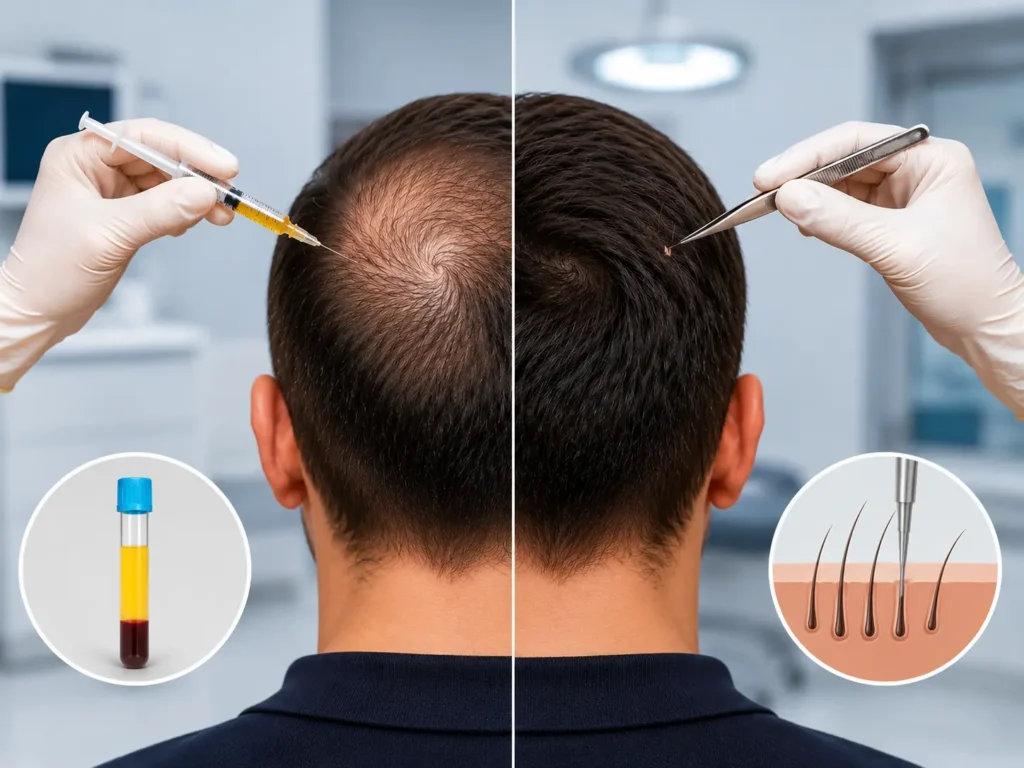
PRP and hair transplants for hair loss are often compared. The best choice depends on how advanced your hair loss is.
- Choose PRP When:
- You have early to moderate thinning with active follicles.
- You want no surgery or scarring.
- You need no downtime.
- You’re not ready to commit to a transplant.
- Choose a Transplant When:
- Follicle loss is advanced.
- The area is completely bald with no active follicles left.
- Previous PRP treatment has reached its limit.
Ready to find the right hair restoration solution? Book a consultation at Karmina Beauty Clinic. Our experts will assess your hair loss, recommend the most suitable treatment, and create a personalised plan to restore thicker, healthier hair.
How Many PRP Sessions to Regrow Hair, and Is It a Permanent Solution
How many PRP sessions are needed to regrow hair? Most patients need three to five sessions at first. These sessions are spaced four to six weeks apart. After that, maintenance sessions occur every six to twelve months.
Is PRP a permanent solution for hair loss? Not in the same way as a transplant is. PRP helps manage and reverse androgenic alopecia. However, since the hormonal factor (DHT sensitivity) remains, maintenance sessions are usually required to keep the results. Clients who maintain their protocol consistently at Karmina Beauty Clinic report sustained density improvement year over year without significant regression.
Does PRP hair treatment really work for men in the long term? The evidence says yes, with maintenance. Men who finish the initial series and come back for annual or biannual follow-ups keep their results. At Karmina Beauty Clinic in Forest Hills, NYC , we structure treatment plans with this long-term view built in from the first consultation.
How Soon Can You See PRP Hair Regrowth Results
Most clients first notice a reduction in daily shedding, which typically happens within three to four weeks after the initial session. Visible new growth and thicker-feeling hair generally begin to appear between months two and three. The most dramatic improvements in density and coverage show up between months four and six after finishing your initial treatment series.
At Karmina Beauty Clinic, clients track their progress with scalp photographs at every visit. This keeps adjustments to the treatment plan completely objective, ensuring it is tailored precisely to how each individual responds.
Conclusion
PRP for hair loss can regrow hair when started early, performed correctly, and maintained consistently. The research supports it, the results are real, and your body’s natural growth factors do the work.
Your hair follicles may still be active. Give them the signal to grow with PRP at Karmina Beauty Clinic. Book your consultation today to receive a personalised treatment plan and start your journey toward thicker, healthier, naturally restored hair before further hair loss occurs.
Frequently Asked Questions
Q1. Does PRP therapy actually regrow hair or just slow shedding?
PRP for hair loss does both. It reduces shedding and stimulates real regrowth in follicles that are still biologically active.
Q2. How effective is PRP for treating male pattern baldness?
Studies confirm PRP treatment for hair loss improves hair count by up to 33 percent and shaft diameter by 22 percent in androgenic alopecia patients.
Q3. What does research say about PRP hair regrowth results?
Multiple controlled studies confirm PRP hair restoration results include measurable density gains of 25 to 45 percent sustained at six-month follow-up.
Q4. Is PRP a permanent solution for hair loss?
No, PRP hair loss before and after results require maintenance sessions every 6 to 12 months to sustain long-term hair density improvements.
Q5. How soon can you see PRP hair regrowth results?
Reduced shedding appears within weeks one to four. Visible PRP hair restoration results in density typically show between months four and six.
Q6. How long does it take for PRP to regrow hair?
Most clients see meaningful regrowth from PRP for hair loss between months two and six after completing the initial treatment series.
Q7. Does PRP work for a receding hairline?
Yes, does PRP work for receding hairline concerns is answered positively when follicles at the recession edge are still active and viable.
Q8. How does PRP compare to a hair transplant for hair loss?
PRP vs hair transplant for hair loss: PRP is non-surgical, costs less, and suits early thinning; transplants suit advanced loss with no active follicles.
Q9. How many PRP sessions does it take to regrow hair?
Most people need three to five initial sessions. How many PRP sessions to regrow hair depends on loss stage and individual follicle response.
Q10. Does PRP hair treatment really work for men?
Yes, does PRP hair treatment really work for men is confirmed by multiple trials showing improved density, thickness, and sustained results with maintenance.
Q11. Is PRP effective for hair loss in women as well?
Yes, is PRP effective for hair loss applies equally to women. Female pattern thinning responds comparably to male androgenic alopecia with proper treatment.
Q12. What does PRP do to the hair follicle?
Platelet-rich plasma growth factors bind to follicle receptors and pull resting follicles back into the active growth phase, producing thicker, stronger strands.