The PRP hair loss vs minoxidil debate comes up in almost every hair consultation because both treatments are popular, both have real evidence behind them, and neither is right for everyone. One is applied at home every single day. The other is a clinic-based procedure done a handful of times per year. One costs a few dollars a month. The other is a more significant investment. Understanding what each actually does to your scalp is how you make the right call for your situation.
This guide puts both treatments side by side using current 2026 clinical evidence. No brand loyalty, no overselling. Just a clear picture of what works, what does not, and what happens when you decide to stop.
How Does PRP Compare to Minoxidil for Hair Loss
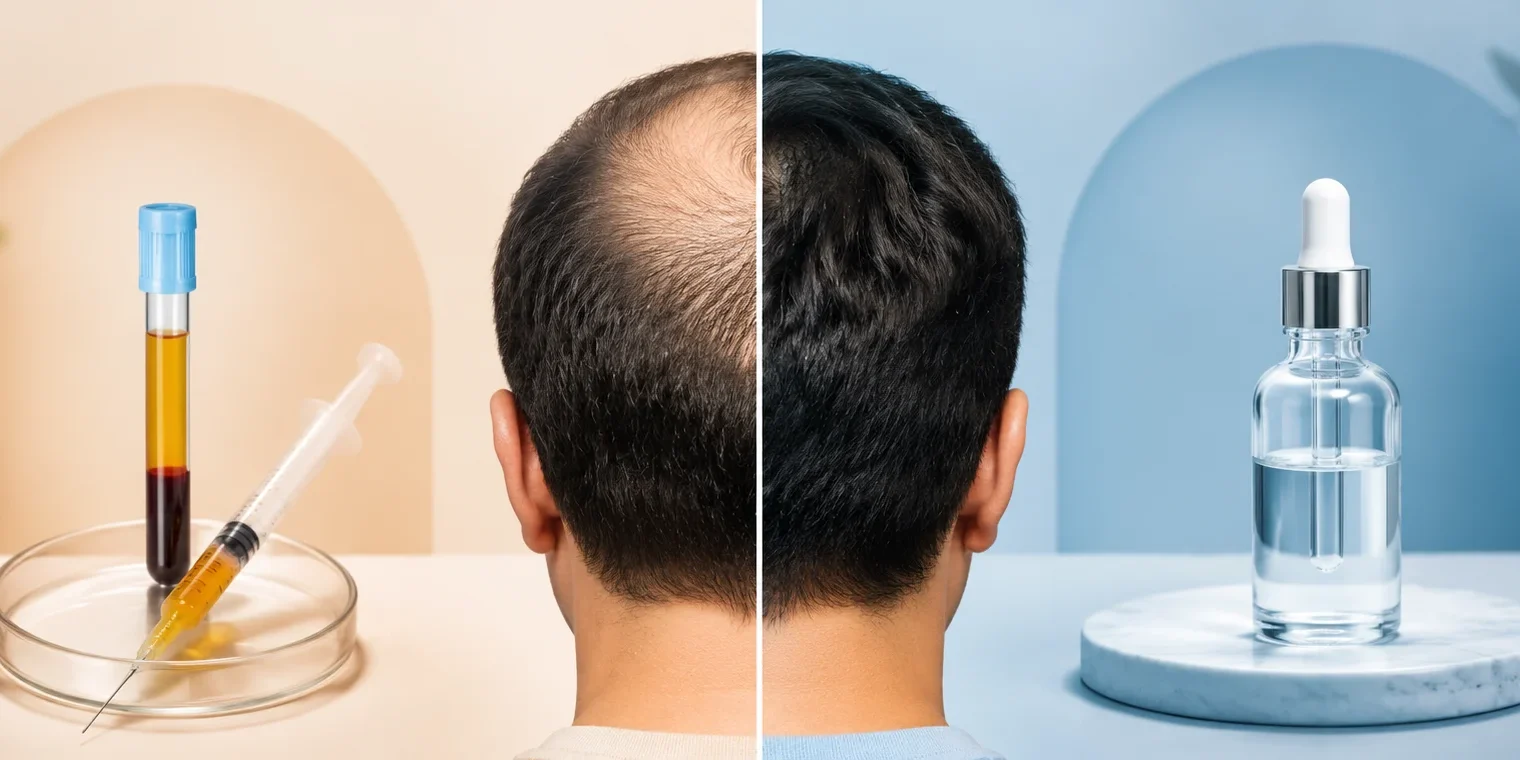
These two treatments take entirely different approaches to the same problem. Platelet-rich plasma hair growth works from inside the follicle using your own biology. Minoxidil works from the outside by increasing blood flow to the scalp.
| Feature | PRP Therapy | Minoxidil |
| Source / Format | Injected concentrated platelets | Daily topical solution or foam |
| Primary Action | Stimulates dormant hair follicles | Widens blood vessels to boost nutrients |
| Treatment Frequency | Monthly clinical sessions | Applied 1 to 2 times daily at home |
| Key Advantage | Uses your body’s natural growth factors | FDA-approved for male-pattern hair loss |
| Target Area | Injected directly into scalp areas | Applied across thinning scalp regions |
The key difference is dependency. Minoxidil for hair loss requires daily use forever. Stop using it and hair loss returns to where it would have been without treatment, usually within 4 to 6 months. PRP hair treatment nyc stimulates the body’s own repair process. Results build over months and remain after the initial treatment course is complete, with only periodic maintenance sessions needed.
Is PRP Better Than Minoxidil for Hair Loss According to Clinical Research
This question now has a concrete answer. A systematic review published in October 2025 in Skin Health and Disease analyzed multiple controlled trials comparing PRP vs minoxidil for androgenetic alopecia. The findings showed that PRP worked similarly to minoxidil for hair count. However, it did better than minoxidil in improving hair density, getting better results on the hair pull test, and scoring higher in patient satisfaction.
A separate randomized controlled trial found that patients treated with PRP had significantly higher satisfaction rates than those on topical minoxidil. A large study found that at week 24, 56% of patients responded well to minoxidil, while only 38% responded to PRP. This suggests that minoxidil may show faster early results for some patients.
What the Evidence Actually Shows
Neither treatment wins outright in every measure. PRP leads on hair density, pull test performance, and long-term patient satisfaction. Minoxidil leads on early response rate and cost. In 2026, the best evidence shows that using both treatments together is the most effective way to treat male pattern baldness.
PRP vs Minoxidil Results: Side Effects and What to Expect
| Comparison Factor | PRP Hair Treatment vs Minoxidil |
| How it works | PRP uses injected growth factors; Minoxidil expands blood vessels for nutrient flow |
| Commitment | 3–6 initial PRP sessions + periodic top-ups vs. daily lifelong Minoxidil application |
| Result Timeline | Minoxidil takes 3–4 months; PRP builds over 3–6 months post-treatment |
| Side Effects | Minoxidil can cause scalp dryness/irritation; PRP causes mild 1–2 day soreness |
| Stopping Effects | Minoxidil gains reverse in 4–6 months; PRP results fade much more gradually |
| FDA Status | Minoxidil is FDA-approved; PRP is clinically supported off-label |
| Cost | Minoxidil is $20–$50/month; PRP is $375–$750/session |
What Happens When You Stop Using Minoxidil
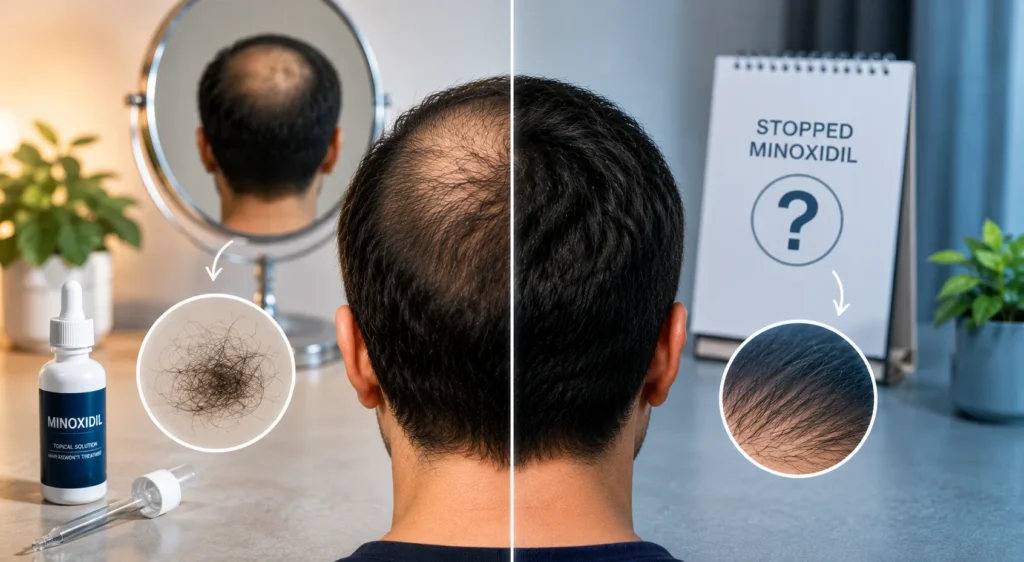
This is the part most people do not fully understand before they start. What happens when you stop using minoxidil is not a gradual slowdown. It is a reversal. Minoxidil does not fix the underlying cause of hair loss, which in most men is the hormone DHT progressively shrinking hair follicles. It creates a sustained environment where follicles function better than they would otherwise. Remove that environment and the follicles return to their pre-treatment trajectory.
Studies consistently show that within 4 to 6 months of stopping minoxidil, shedding increases, and the hair density that builds up during treatment is lost. This is a permanent commitment, not a course of treatment with an end date. For men who find that uncomfortable, non-surgical hair restoration with PRP is a better long-term option.
Note: If you are currently using minoxidil and considering switching to PRP, do not stop abruptly without a plan. Speak to your practitioner about a transition strategy that avoids a gap period where shedding accelerates before PRP results have time to build.
Can You Use PRP and Minoxidil Together
Yes, and the clinical evidence strongly supports it. Combining PRP with minoxidil produces better outcomes than either treatment used alone. A meta-analysis of five randomized controlled trials found that hair density was significantly higher at one month, three months, and five to six months in the PRP plus minoxidil group compared to the minoxidil alone group.
A three-arm study looked at minoxidil alone, PRP alone, and their combination. The results showed that using both treatments together nearly tripled hair density improvement compared to PRP alone. The best results in all studies came from combining both treatments with microneedling as a third element.
For men dealing with androgenetic alopecia treatment or a receding hairline, the practical approach in 2026 is to use both. PRP addresses follicle-level regeneration and hair density. Minoxidil maintains the scalp environment between PRP sessions. Together, they target the problem from two different angles simultaneously.
PRP Hair Restoration for Men at Karmina Beauty Clinic NYC
PRP hair treatment in NYC at Karmina Beauty Clinic in Forest Hills, Queens, is a one-hour session using your own blood to target thinning areas of the scalp. Blood is drawn and spun in a centrifuge. This isolates the platelet-rich plasma. Then, it’s injected into areas with thinning hair and damaged follicles. Each session is built around your specific thinning pattern and scalp condition.
Most men need 3 to 5 sessions spaced 4 to 6 weeks apart for the initial treatment course. Maintenance sessions follow every 4 to 6 months. PRP hair restoration NYC cost at Karmina starts at $375 for a single session. A 5-session package is available at $1,500, saving 20%, with financing from $19 per month through Cherry. Male hair loss treatment options in 2026 at the clinic also include combining PRP with microneedling for enhanced follicle stimulation results.
Find Out Which Treatment Is Right for You
PRP and minoxidil are not competing solutions. They target different aspects of hair loss through entirely different mechanisms. For men who want daily independence and long-term follicle regeneration, PRP is the stronger standalone choice. For men who want the lowest-cost entry point, minoxidil works but demands permanent daily commitment. For men who want the best possible outcome, current clinical evidence in 2026 points clearly to combining both. The decision is not which one works. It is whichever one fits your life.
Book a PRP hair restoration consultation at Karmina Beauty Clinic in Forest Hills, Queens, NYC. Your scalp is assessed, and a personalized treatment plan is built around your stage of hair loss.
Frequently Asked Questions
Q1. Does PRP work better than minoxidil for hair loss?
PRP outperforms minoxidil on hair density and patient satisfaction. Minoxidil shows faster early results in some patients based on 2025 trials.
Q2. Can PRP replace minoxidil completely?
Yes, PRP can be used as a standalone treatment without minoxidil. Combining both produces better outcomes than either treatment alone.
Q3. What are the side effects of minoxidil vs PRP?
Minoxidil can cause scalp irritation and unwanted facial hair. PRP causes only mild scalp soreness for 1 to 2 days after each session.
Q4. How long do PRP results last compared to minoxidil?
PRP results hold for months after treatment ends. Minoxidil results reverse within 4 to 6 months once you stop using it daily.
Q5. Is PRP FDA approved for hair loss in 2026?
PRP is not FDA-approved specifically for hair loss but has strong clinical trial evidence and is widely used off-label by specialists globally.
Q6. Can you use PRP and minoxidil at the same time?
Yes, combining PRP with minoxidil significantly improves hair density outcomes compared to using either treatment on its own, according to clinical studies.
Q7. How long does minoxidil take to work vs PRP?
Minoxidil shows early results in 3 to 4 months. PRP results are visible at 3 to 6 months after completing the full initial treatment course.
Q8. Does PRP hair treatment really work for male pattern baldness?
Yes, multiple clinical trials confirm PRP improves hair density and reduces shedding in men with androgenetic alopecia and early pattern baldness.